
SLAC Small Business Program
Small Business Opportunities
SLAC actively partners with small businesses to support our research mission. Each year, SLAC awards millions of dollars in contracts to small businesses that meet the U.S. Small Business Administration (SBA) definition of small business. The SBA definition of a small business varies by industry and governs what qualifies as a small business for government contracts and resources.
Each company’s size status is determined by its North American Industry Classification System (NAICS) code and the corresponding SBA size standards. These are established using employee counts or average annual receipts to define a small business within each sector. When registering in the System for Award Management (SAM.gov), vendors self-certify their small business status.
To learn more about what constitutes a small business and small business size standards, visit the U.S. Department of State’s guide on “What Is a Small Business” or read our FAQ’s below.
GROW WITH US
SLAC supports small businesses
SLAC’s program helps small businesses connect, qualify, and compete. Below you’ll find resources, partnership opportunities, and answers to the most common questions about small business and government contracts.
SLAC's Small Business Program
SLAC is dedicated to expanding procurement opportunities for small businesses and collaborating with small business suppliers in research, construction, technology, and services. We align our small business program with the standards set by the U.S. Small Business Administration (SBA) to expand participation by small disadvantaged businesses and other SBA socioeconomic categories, while supporting the laboratory's mission.

PROGRAM TARGETS
Our commitment
Each fiscal year, SLAC establishes a small business goal and pursues initiatives that grow small business government contracts, small business procurement, and equitable participation across all socioeconomic categories.

PROGRAM GOALS
Our objectives
1. Support small businesses in providing goods and services that assist SLAC’s organizational mission.
2. Build upon existing small business outreach programs.
3. Find new ways to support the small business community and pursue initiatives that grow small business government contract awards.
Small Business Government Contracts at SLAC
SLAC adheres to federal acquisition regulations and the DOE small business subcontracting plan goals to ensure fair access to government contracts for small businesses. We collaborate with SBA-recognized categories to expand small business government contracting and small business participation in government contracts.
Whether through direct awards or subcontracts, small and disadvantaged business partners remain essential to SLAC’s mission. Keep reading to see SLAC’s annual small business commitment and achievements.
Small Business Spend Report
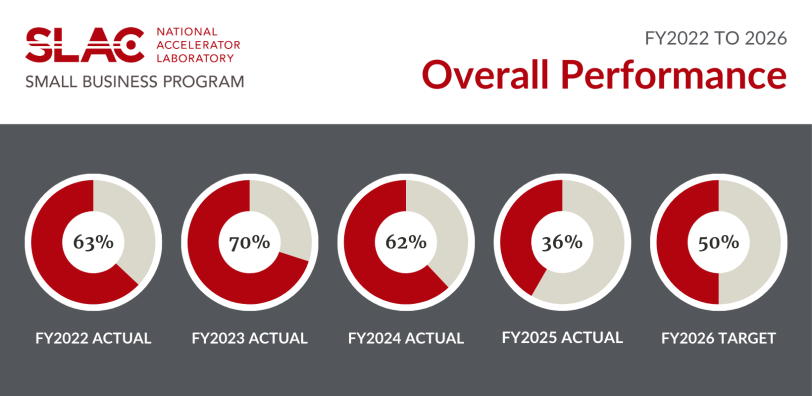
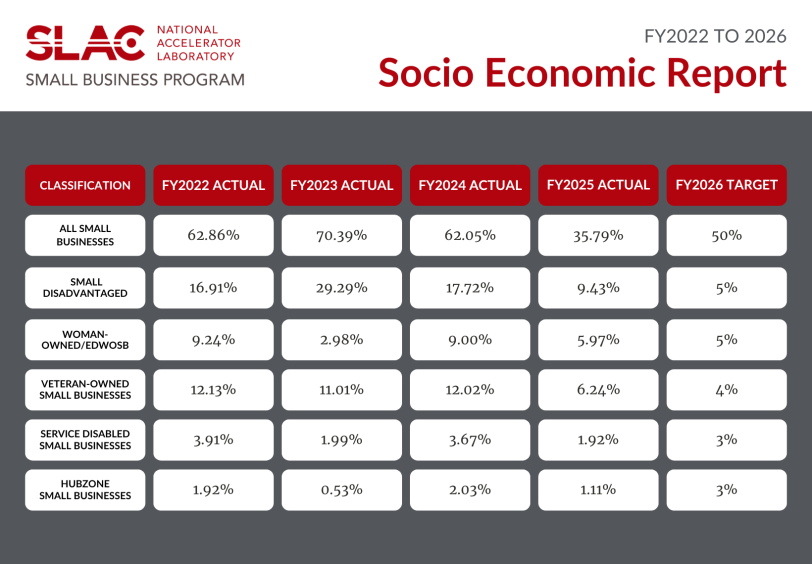
In fiscal year 2025 (FY2025), SLAC awarded over $107 million to small business suppliers representing 35.79% of total procurement spend. This is equivalent to a 27.91 percent increase in overall small business procurement at SLAC compared to FY2024. Although this is below FY2025’s target percentage, it marks a 27.91% increase in overall small business spending. This highlights SLAC’s ongoing dedication to small business procurement and community-driven growth.
Year-Over-Year Spend Differentials
Several large-scale capital improvement projects, including the LSCC and LEIT tunnel construction initiatives and the CUIR infrastructure program, contributed to an increase in total procurement spending in FY2025. These federally funded projects, essential to the Lab’s long-term research capabilities, temporarily shifted spending toward major construction contracts while still resulting in record growth in total small business contract value.
FY2025 Small Business Goals & Actuals
Despite proportional shifts, small disadvantaged businesses (9.43%), woman-owned small businesses (5.97%), and veteran-owned small businesses (6.24%) all surpassed FY2025 targets, highlighting SLAC’s strong commitment to expanding opportunities for small businesses across all socioeconomic categories. While Service-Disabled Veteran-Owned Small Businesses (1.92%) and HUBZone Small Businesses (1.11%) fell slightly below target, SLAC remains dedicated to increasing participation from these sectors in upcoming procurement cycles.
Through these dedicated efforts, SLAC continues to make significant progress toward its small business goals—fostering opportunity, innovation, and equity, and creating a lasting, positive impact in small business procurement.
Fast Facts
According to the U.S. Small Business Administration (SBA), small businesses account for approximately 44% of the U.S. GDP.
Small businesses employ roughly 46% of the U.S. private sector workforce.
Moreover, small businesses created nearly two-thirds of all American jobs in the past two decades.
Nicole Colley, Operations Strategy Manager, SCM“Small businesses are vital to the U.S. economy and the research conducted at SLAC.
As a U.S. Department of Energy National Lab, SLAC is committed to ensuring all businesses have an equal opportunity to compete and receive contracts. Supporting small businesses through SLAC’s procurement process is essential to the lab’s mission, benefiting science and advancing humanity. That is our commitment.”

Mentor-Protégé Program
SLAC participates in the Department of Energy (DOE) Mentor-Protégé Program to support the Department of Energy's small business subcontracting program and help firms qualify as small business suppliers to government agencies.
If you’re interested in applying, watch the video below to learn about the program’s background, its benefits for both proteges and mentors, eligibility requirements, and how to participate.
DOE’s OSDBU Mentor-Protégé Program (MPP)
SLAC & DOE Mentor-Protégé Program Benefits
- Builds readiness for government contracts for small businesses.
- Educates small business owners and opens paths to federal small business contracts as a prime or subcontractor.
- Guides on developing a compliant small business subcontracting plan.
- Introduces firms to varied types of government contracts for small businesses and DOE project requirements.
MPP Details
Applicants interested in applying to work with SLAC in the DOE MMP must meet the following program requirements:
- Must be certified as an 8(A) business:
- Small Disadvantaged Businesses
- Women-Owned Small Businesses
- Veteran-Owned and Service-Disabled Veteran-Owned Small Businesses
- HUBZone Small Businesses
- Historically Black Colleges & Universities (HBCUs) or Minority Education Institutions
- Must be certified as a small business with a NAICS Code for the goods or services offered
- Must be in business for a minimum of two years before applying
- Must have at least two employees
- Must be eligible for work under a government contract
- Must have previously completed a federal contract
- Demonstrate business ownership, management commitment, and involvement
Potential protégé companies who wish to apply should contact Nicole Colley, Operations Strategy Manager, SCM.
Upcoming outreach events
Explore SLAC’s upcoming small business outreach events to connect with buyers and prime contractors. If no events are listed, then none are currently scheduled. Please remember to check back frequently for updates.
FAQs
Below you’ll find answers to common questions related to SLAC’s Small Business Program and small business contracts with government agencies.
If you are registered as a small business with the U.S. Small Business Administration (SBA) and want to become a SLAC small business supplier, please complete and submit the Prospective Supplier Information or Construction Pre-qualification Form.
NOTE
Completing these forms does not guarantee that solicitations or awards will be granted to your business or that your business will be included in SLAC’s pre-approved supplier database.
SLAC provides prospective suppliers with a reasonable opportunity to become familiar with our procurement requirements and offers several support channels.
If you have additional questions, please contact Nicole Colley, Operations Strategy Manager, SCM.
SLAC and the U.S. SBA classify small business concerns as those that meet the following criteria:
- Organized for profit
- Located in the U.S
- Operates primarily within the U.S. or makes a significant contribution to the U.S. economy through payment of taxes or use of American products, materials, or labor
- Independently owned and operated, and not a national leader in its field
SLAC’s policy provides opportunities to small business concerns that are:
- 8(a) small businesses
- HUBZone small business concerns
- Small disadvantaged business concerns
- Women-owned
- Veteran-owned
- Service-disabled veteran-owned
SOURCE: U.S. Department of State
To learn how to register as a small business, review the SBA’s comprehensive guide for business owners here.
What constitutes a small business varies by industry. The definition of a small business differs across various sectors. A small business aligns with the SBA's criteria based on size standards associated with the NAICS codes relevant to government contracts. According to the Small Business Administration (SBA), to be eligible for government-set-aside contracts and small business set-asides, a company must meet the agency's established size requirements.
Eligibility depends on SBA size standards for the applicable small business NAICS codes and self-certification in SAM.gov. Business owners and administrators can self-certify as small through their SAM.gov registration.
Learn all you need to know about small business status here.
A firm qualifies if it falls within the SBA size standard for its NAICS industry and meets requirements to compete for small business contracts and small business contracts with government agencies.
The U.S. Small Business Administration (SBA) is the federal agency that establishes the SBA small business definition and supports small business government contracting programs across federal agencies. The SBA provides a wide range of services to help small businesses start, grow, and compete for government contracts.
Its programs include:
- Financing and capital access: SBA loans, investment programs, and grants that help small businesses secure funding to expand operations or manage cash flow.
- Entrepreneurial development: Through the SBA Learning Platform, you’ll find coaching and training programs to help businesses at any stage.
- Government contracting assistance: Resources such as the government contracting guide, counseling and help, mentorship program, 8(a) Business Development Program, HUBZone certification, and Women-Owned Small Business (WOSB) program, and Veteran contracting assistance programs that prepare firms to qualify for small business federal contracts.
- Disaster assistance: Financial support for small businesses recovering from declared disasters.
Through these services, the SBA strengthens the nation’s economy by helping small and disadvantaged business owners access the resources, networks, and federal opportunities they need to succeed.
How to get government contracts for a small business
The best place to begin learning about government contracts for small businesses is through the Small Business Administration (SBA). The SBA offers step-by-step contracting guides, online courses, and resources to help small companies identify opportunities and prepare competitive bids.
From SBA.gov, you can:
- Review the SBA’s Government Contracting Guide and Learning Center, which outlines programs, certification requirements, and proposal basics.
- Register and self-certify your business in SAM.gov, the federal system used to award small business government contracts.
- Explore the SBA’s contracting assistance programs, including 8(a), HUBZone, Women-Owned, and Service-Disabled Veteran-Owned certifications.
- Connect with SLAC through the DOE Mentor-Protégé Program, which helps qualified small businesses gain experience, build capacity, and strengthen their readiness to compete for small business procurement opportunities.
- Attend one of SLAC’s small business events.
These resources will help you understand eligibility, registration, and how to position your company for success in small business and government contracts.
Set-asides, sole-source awards, and subcontracts under a prime’s small business subcontracting plan are the most common types of government contracts for small businesses.
These opportunities allow eligible firms to enter the small business and government-contracts marketplace through both competitive and non-competitive awards.
You can search SAM.gov for upcoming solicitations and opportunities.
A small business concern is:
- Organized for profit
- Operates primarily within the U.S.
- Meets SBA size standards under small business NAICS codes
These firms are eligible to pursue small business federal contracts and participate in small business government contracting programs.


